Value Creation with Reduced Emissions from Waste (VCREW) Feb 13th, 2026
About the project
Engineers Without Borders Norway (EWB-Norway) together with its partners World Food Programme (WFP) and The Stromme Foundation (SF) seek to develop solutions for more sustainable management of non-recyclable waste in humanitarian contexts, where current practices often result in harmful emissions from open burning and waste and plastic pollution in the environment.
During the first phase of the project (February–December 2025), the project partners, together with Human Brights AS, explored a combined pyrolysis/incineration solution. However, field visits to both Kenya and Uganda, strengthened understanding of local needs and preferences, and a decision was made to open for additional technologies and methods.
The Challenge
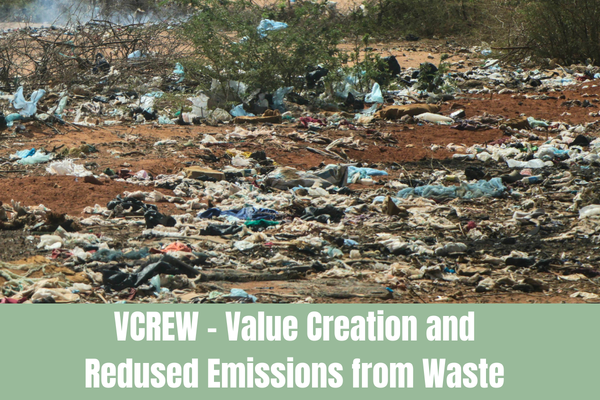
Plastic is widely used due to its low cost and long-lasting properties. This durability means that plastic remains in the environment and food chain if not properly disposed of. In low-resource locations there is often a lack of waste treatment infrastructure, resulting in environmental and health hazards from plastics accumulating in nature or being burned in open pits.
The World Food Programme (WFP) and other humanitarian organizations generate substantial waste in delivery to remote, low-resource locations. A 2021 USAID-WFP study revealed that nine humanitarian organizations sent over 68,000 metric tons of packaging to recipient countries, much of it plastic, including 5,000 metric tons of non-recyclable metallized sachets.
Problem statement
Humanitarian aid includes the supply of food, which often uses plastic or multilayer packaging to avoid degradation of the product. The delivery location is often remote, and with limited infrastructure for waste handling or for developing waste treatment solutions. Similar challenges exist also in low-resource settings. High transport costs, low recycling value, and lack of systematic collection further hinder effective waste management.
Without sustainable solutions tailored to these contexts, plastic waste will continue to disrupt ecosystems, contaminate water, and worsen health disparities in low-resource areas. Plastic is a durable material with high energy potential, creating an opportunity to develop disposal solutions that both reduce plastic waste and generate value from it.
Technology gap
Two case studies are identified for the project: Dadaab displaced persons settlement in Kenya, and the Butambala region in Uganda. Despite the distance to end-user markets, recyclable plastics such as PET bottles and HDPE containers have been collected and sent for recycling, with partial solutions existing through local reuse or industrial recycling in urban areas.
Solutions do not currently exist for low value plastics such as polyethylene carrybags, or multilayer packaging sachets (that often include metallised PET). The project is aimed at developing and demonstrating a solution for removing these low-value plastics from the environment, while creating value adapted to the local needs. The solution should take into account the following:
- Processing needs should be suitably simple and adapted to the low resource setting
- There is limited electricity, water and workshops for mechanical and electrical fabrication
- It must be safe and able to be operated by local employees
To our knowledge, there are no portable, non-electric units designed for deployment in remote or challenging settings. Our approach aims to fill this gap, providing a more sustainable and adaptable solution for such environments.
Project status
In the first phase of the project different waste processing alternatives have been evaluated and compared with the identified local needs. In the next phase involving the Market Dialogue it is desired to be open to new proposals, while still providing feedback on these from the initial evaluations and the needs assessment. A baseline concept is provided as a reference point to illustrate the scope, scale and integration with the local community.
Baseline: (describe two-stage incineration with emission cleaning, at around 20 kg/h scale generating waste heat. Outline the challenges of utilising or storing this waste heat, resulting in it being used to provide external heating to produce charcoal from wood. This charcoal would then become a cooking fuel of improved quality than the wood.)
From existing experience and observations, several impediments have been identified that could affect the implementation of plastic waste processing solutions:
- Safety concerns with pyrolysis products: Storing gas or liquid fuels generated from pyrolysis presents safety risks.
- User familiarity and safety: Communities may lack experience with handling gas or liquid cooking fuels safely.
- Electricity limitations: Produced electricity may be difficult to store or distribute due to lack of reticulation infrastructure.
- Heat utilization challenges: Direct use of heat for cooking is problematic when kitchens are located near waste collection and treatment areas.
- Material handling issues: PET in metallised multilayer packaging poses difficulties in processing and handling.
- Plastic-based construction materials: Use of plastic bricks carries the risk of microplastics escaping into the environment and poses end-of-life disposal challenges.
- Other potential obstacles: Further technical, social, and environmental factors may emerge depending on local context.
Baseline Case.docx
VCREW mission report_updated V2
VCREW Needs Assessment - Report _Stromme Foundation_Revised 2026
WFP Needs assessment report updated V2
link to needs assesment kenya and uganada will be shared shortly
Agenda
- Welcome from EWB-Norway and Opening Remarks
- Presentation on the challenge by WFP/SF
- Presentation on baseline case.
- EWB-Norway, what we are looking for.
- Discussion around the table presentations.
- Closing Remarks and the prosses forward.
What You Can Expect
- A platform for sharing knowledge, ideas, and experiences.
- Discussion and opportunities to connect with industry leaders, technology providers, and funding bodies.
- Identification of potential partnerships to co-develop and test new remediation technologies.
- A summary of key takeaways and recommendations to inform future market engagement strategies.
The partner selected for this task will collaborate closely with the EWB-Norway as well as the local implementing partners (World Food Programme and Strømme Foundation).
For question and clarification:
|
Nima Nemati Saeid Marianne Nilsen Sturmair |