REQUEST FOR PROPOSAL (RFP) VCREW by 12th of April 2026
Introduction
The Value Creation and Reduced Emissions from Waste (VCREW) project is a collaborative initiative led by Engineers Without Borders Norway, in partnership with World Food Programme and Stromme Foundation.
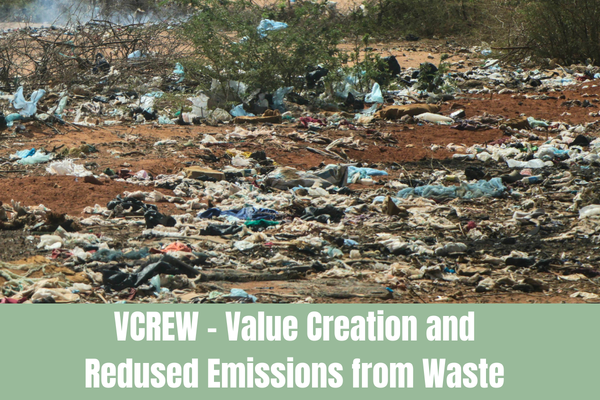
In displacement affected and low infrastructure contexts, large volumes of waste, including thin polythene, multilayer sachets, and mixed plastics have little or no recycling value. Due to limited waste management infrastructure, high transport costs, and lack of formal landfills, these materials are frequently openly dumped or openly burned.
The project aims to reduce plastic pollution and harmful emissions resulting from the open burning of unrecyclable waste in rural, low-resource areas, while identifying and setting-up revenue-generating activities along the waste value chain that create livelihood opportunities for local communities and sustain the economic viability of the proposed solution. Our vision is to produce a scalable end-to-end solution for waste management in remote environments. A solution tailored for both humanitarian response and long-term development. We are looking for partners to help us fulfil this vision as far as feasible.
We aim to find the right partner(s) to join us in fulfilling the project aims and to:
Develop and design an integrated and fit for purpose solution for collection, recycling/disposal of non-recyclable or hard-to-recycle plastic waste and systems for creating local value, targeting at a minimum, non-recyclable or hard-to-recycle plastic waste in humanitarian and development settings. Providers may also target additional waste streams, provided that low value plastic is included in their approach.
We invite proposals for a solution that delivers one or more of the following:
- Safe treatment of hard-to-recycle plastics (e.g., polyethylene carry bags,
multilayer food packaging sachets (including metallised PET), that are currently dumped/burned openly. - Reduced harmful emissions versus uncontrolled open burning/dumping.
- Clear pathway to local value creation, (e.g., products, services, livelihoods, financial support mechanisms,
or other measurable benefits), including roles/responsibilities and who benefits. - Develop and implement solution based on local needs, in collaboration with local stakeholders at pilot sites;
Dadaab, Kenya, and Butambala District, Uganda.
The proposed solution will be integrated into existing local waste management systems and should demonstrate simple, safe, and practical operating conditions.
We are looking for partners with a solid understanding of the challenge, proven technical capacity in co-development/design/engineering and the ability to physically operationalize the solution. Eligible and interested private companies are invited to implement a solution with value creation in collaboration with local stakeholders by 1st December 2026. If needed, a project time extension is possible.
Below you will find the RFP, important related project documents and more information about Humanitarian Innovation Programme.
Documents:
REQUEST FOR PROPOSAL-VCREW-EWB-N. RFP260310.docx
REQUEST FOR PROPOSAL-VCREW-EWB-N. RFP260310.pdf
EWB-N - VCREW presentation.pdf
MD meeting minutes VCREW. 13.02.26.pdf
VCREW - WFP mission report Kenya.pdf
VCREW - WFP Needs assessment report - Kenya.pdf
VCREW Needs Assessment - Report _Stromme Foundation.pdf
We are seeking partners with the following qualities:
- Strong technical knowledge and expertise
- Experience in system design for end-to-end waste management solutions
- An understanding of the local context and community needs
- Demonstrated flexibility, collaborative spirit, and an innovative mindset
A digital RFP Q&A session will be held on 17 March 2026 at 13:00 CET. All questions and clarifications related to the RFP will be published on the EWB/RFP webpage. Click here to participate in the Q&A
|
For question and clarification: Deadline 20.03.2026 Engineers Without Borders Norway (EWB-Norway) Official/Contact Person:
Proposal submission Deadline 12.04.2026 Engineers Without Borders Norway (EWB-Norway)
|
Nima Nemati Saeid Marianne Nilsen Sturmair |
Questions and Answers:
RFP Q&A Session, 17 March 2026
Updated 23 March 2026
1. Local labor costs
Question: Can Engineers Without Borders WFP or the Stromme Foundation provide support in understanding local labor costs in Kenya, Dadaab, and Uganda?
Answer: Yes. We will provide this information as soon as possible and upload it to the RFP webpage.
SF response for Uganda:
• Waste Collectors (unskilled) Per day is Ugx.10,000 (Approx. $2.5)
• Waste Sorters (Semi-skilled) Per day is Ugx.15,000 (Approx. $4)
• Truck Assistants/Loaders Per day Ugx.12,000 (Approx. $3.3)
• Supervisor (Site/Operations) Per month Ugx.800,000 ($222)
• Skilled Labor (Construction/Technical) Per day Ugx.35,000 (Approx.$8)
• Community Mobilizers Per day Ugx.20,000 ($5.5)
WFP response for Kenya:
Please the link here to minimum wages as prescribed by Kenyan labour laws.
2. Role of EWB, WFP and SF
Question: What will be the role of the project partners, and what can we from the private sector expect?
Answer: We will act as a project partner to the private sector. We aim to collaborate wherever possible, including co-developing, co-creating, and co-implementing solutions. However, private partners will be responsible for their own activities as outlined in their tender submissions. In addition, we shall be your link to the target communities/stakeholders, advise on factors influencing labor pricing, including seasonality (planting/harvest periods), inflation, and local market dynamics.
3. Terms of payment
Question: Can the terms of payment be flexible?
Answer: Yes, terms of payment can be flexible and will depend on the proposed budget and payment plan from the partner.
4. Scope – collection
Question: Is it essential to include collection as part of the scope of work?
Answer: To some extent, yes. A minimum understanding of collection is required. We will not exclude applications that do not offer a full system. However, applicants should demonstrate how collection can be addressed, including collaboration in the field and integration into their solution.
5. Photos of plastics
Question: Can you provide more photos of the plastics?
Answer: Yes. Click on this link to see the additional photos.
6. Compliance documents
Question: Are there any additional compliance documents required?
Answer: No. All required compliance documents are included in the RFP.
7. Application format and length
Question: Is there a page limit, and how should we structure the response?
Answer: Keep the application concise, clear, and to the point. Respond directly to the outlined sections and activities. For sections requiring yes/no answers, these can be copied into your application and completed accordingly.
8. Additional assessment information
Q: Are there any additional assessments (e.g., CARE assessments) that can be shared?
A: All relevant assessments have already been shared. Relevant additional assessments like CARE assessments will be shared and uploaded to the RFP webpage.
9. Project Objectives
To co-develop an end-to-end waste management solution, from collection to sustainable end-of-life management, in Dadaab (Kenya) and Butambala District (Uganda).
Q: Are these two separate projects, or one single project?
A: The project aims to address challenges in both Uganda and Kenya. The solutions do not need to be identical for both sites. Applicants may propose solutions for one or both locations.
10. Maximum Project Funding
Maximum available funding: NOK 4,000,000
Q: Does this funding apply to one project or both sites?
A: The funding is intended to support solutions addressing challenges across both implementation sites.
11. Availability of Land
Q: How much land will be allocated at each site?
A: Land availability will depend on the specific needs of the proposed solution. Multiple options may be considered.
12. Project Intended Outcomes
Q: Is the project limited to identifying and setting up revenue-generating activities along the waste value chain, or can it also include value-added solutions such as waste-to-fuel, energy, or gas?
A: We are open to all solutions that address the project objectives, including value-added approaches such as waste-to-energy, fuel, or gas.
KPIs/Outcomes
These are to be determined in detail once a specific solution(s) is selected. However overall project outcomes should achieve:
• Reduced plastic accumulation
• Elimination/reduction of open burning and dumping
• Economically viable waste management systems
• Appropriate integration into local contexts